Ever stared at a blank page with that blinking cursor mocking you? It's tough, right? When you're looking for ideas for introductions, the goal is simple: grab your audience in the first few seconds and make them need to see what's next. A great hook isn't just a nice-to-have; it's your secret weapon for keeping people glued to your content.
Why the First Five Seconds Make or Break Your Content
Think about how you use the internet. When you click on a YouTube video, how long does it take you to decide if you're going to keep watching or click away? If you're like most people, you make that choice in just a few seconds. It's not that we're impatient; it's just how our brains are built to sort through tons of information.
We're all swimming in a sea of content, so your first impression is usually your only one. A weak or boring start tells your audience, "Hey, your time is better spent somewhere else." Studies on this are clear: a huge chunk of viewers will leave a video or a webpage in under 15 seconds if you don't give them a reason to stay. That tiny window is your only shot to prove you're worth their time.
The Brain Science Behind a Great Hook
A killer intro does more than just say, "Here's what I'm talking about." It taps into basic human psychology by creating something called an "open loop"—it's like a cliffhanger that your brain desperately wants to see the end of. When you lead with a surprising fact, a problem everyone can relate to, or a bold statement, you create an itch that your audience just has to scratch.
Getting them hooked from the start is a big deal for a few reasons:
- It builds trust instantly. When you show you get their problem, they feel like you're on their side.
- It makes them curious. An unexpected opening makes people think, "What happens next?" or "How is that even possible?"
- It sets the vibe. Your intro immediately tells people if your content is going to be fun, serious, nerdy, or inspiring.
How This Works in the Real World
Let's make this real. For a YouTuber, a sharp, snappy intro can make people watch longer, which is a huge signal to the YouTube algorithm to show your video to more people. If you want a deep dive on this, our guide on how to make a video intro breaks down the steps for creators. For a blogger, that first paragraph is what keeps readers scrolling down the page.
Your title's job is to get them to click. Your introduction's job is to get them to stay. If the intro fails, the title was a waste of time.
Bottom line: stop thinking of your introduction as just a warm-up. Start treating it like the most important tool you have. It's your single best chance to grab attention and make sure all your hard work gets the audience it deserves.
The Foundation of an Unforgettable Introduction
Before you even think about writing that perfect opening line, the best creators I know do the same thing: they plan. This isn't boring homework; it’s the secret to making the writing part way easier.
The first question is always the most important: What's my goal? Are you trying to teach a skill, make someone laugh, or maybe convince them to see something in a totally new way? Nailing down your main goal is like setting the destination in your GPS. It guides every choice you make and ensures your intro has a clear point.
Know Your Audience Before You Say a Word
Once you know your "why," it's time to figure out your "who." You don't need to create complicated profiles. Just get a clear picture of the person on the other side of the screen by asking a few simple questions.
- Who are they, really? Are they total beginners looking for the basics, or are they experts looking for advanced tricks?
- What problem are they trying to solve? People look for content because they need an answer. Your intro has to immediately show that you understand their struggle.
- What do they already think about this topic? Knowing what they believe lets you either agree with them or challenge their ideas in a way that pulls them in.
This infographic shows the super-quick journey your viewer takes in those first few seconds.
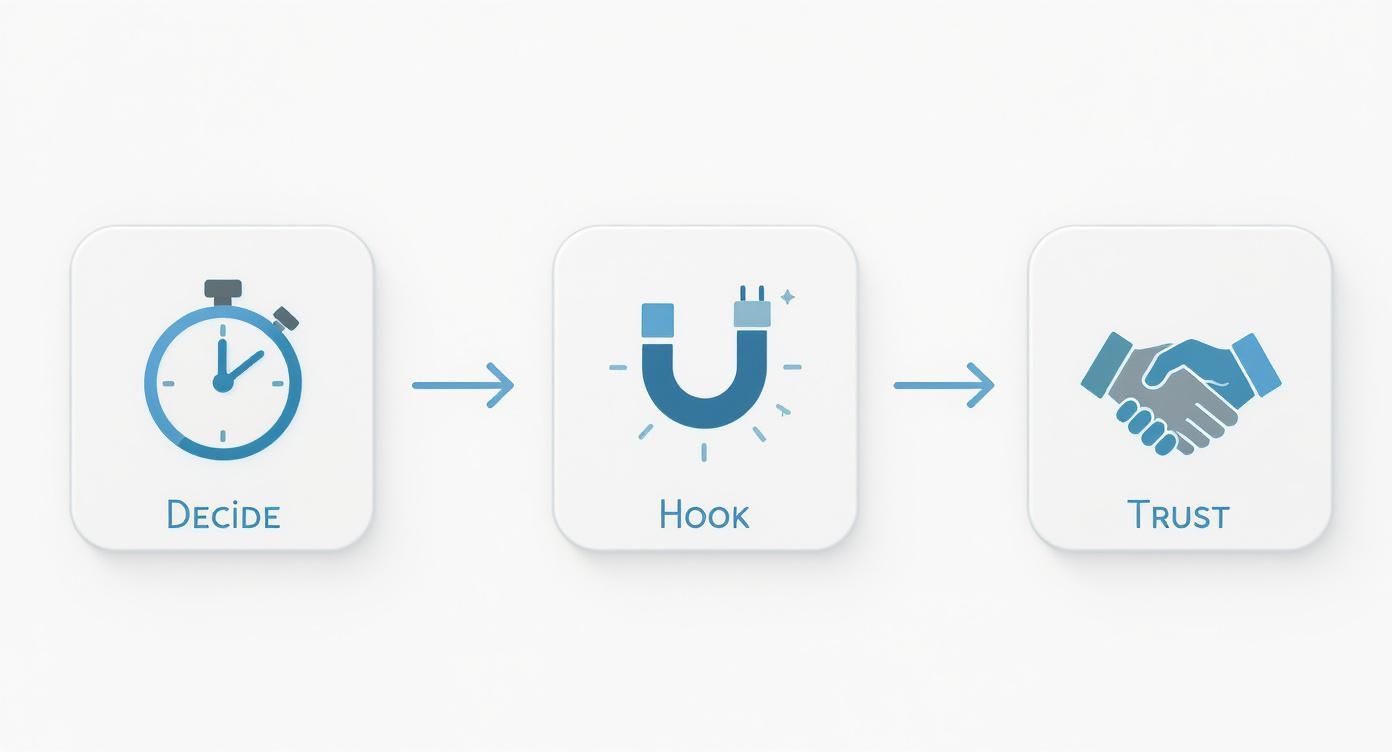
As you can see, that jump from "Okay, I'll check this out" to "I trust this person" happens in a flash. Your hook is the bridge that gets them there.
Finding the Right Vibe
With your goal and audience sorted, the last piece of the puzzle is your tone—basically, the personality of your content. Should you be funny and casual? Or maybe more of an expert and straight-to-the-point? The right tone makes your content feel real and helps you connect with people from the very first word.
Think about it this way: a tutorial on how to animate a logo would probably work best with a simple, encouraging tone. But a video essay about the history of movies might call for something more dramatic and thoughtful.
To help you brainstorm these key ideas, I've found that using different effective note-taking methods can be a huge help. It stops you from writing an intro that feels completely disconnected from the rest of your content.
A great introduction isn't about using the fanciest words; it's about making a promise to your audience that you understand them and have something useful to share.
Nailing this foundation—your goal, audience, and tone—turns the scary task of writing an intro into something simple and clear. You're no longer just throwing ideas at a blank page. You're talking directly to a real person who needs to hear what you have to say.
10 Creative Hooks to Grab Your Audience Immediately
Alright, this is where the fun starts. We're going beyond the boring "ask a question" advice and getting into a playbook of proven ideas for introductions. For each hook, I'll explain why it works and give you a real-world example so you can see it in action.
Think of this as your toolkit for starting any piece of content with a serious punch.
Start With a Shocking Statistic
Numbers don't lie, and a surprising one can instantly make your audience pay attention. The key is to find a statistic that is both unexpected and directly related to the problem you're about to solve. It makes you sound like you know your stuff and makes people curious.
For example, a video about starting an online business could open like this: "In 1995, only about 1% of the world had internet. By 2020, that number exploded to over 4.66 billion people." That's not just a cool fact; it shows a massive shift that changes everything for new businesses.
Share a Relatable Personal Story
Facts tell, but stories sell. Kicking things off with a short, personal story that shows a common struggle builds an instant human connection. It shows your audience that you’ve been where they are and you get it.
A video about public speaking could start with: "My hands were shaking so badly I could barely hold my notes. I looked out at the crowd, took a deep breath, and… nothing came out."
That kind of honesty is powerful. It makes people want to hear how you got through that moment.
Make a Bold and Controversial Statement
One of the quickest ways to get attention is to challenge something everyone believes. A bold, controversial statement makes people stop scrolling and think, "Wait, what?" It forces them to listen to your idea, whether they agree or not.
Why it works: It makes people feel something. They'll keep watching either to prove you wrong or to see how you could possibly back up such a wild claim.
Here are a few ways to frame this:
- "Everything you've been taught about [topic] is wrong."
- "The most common advice for [goal] is actually hurting your progress."
- "I'm about to say something that might make some people mad…"
Open With a Powerful Visual
In a video, what you see first is just as important as what you hear first. A dramatic slow-motion shot, a stunning landscape, or a weird, out-of-context image can create an instant sense of mystery. The audience is immediately hooked, trying to figure out what they’re seeing and what it means.
If you're looking for cool ideas on this, you might like our guide on how to create cinematic style intros, which goes deep into this idea.
Drop Them Right Into the Action
This trick is a classic in storytelling. Instead of a slow build-up, you start right in the middle of the most exciting part. You can always go back later and explain how you got there.
A travel vlog could open with the creator running through a busy market, yelling, "I can't believe this is happening!" The viewer has no choice but to stick around to find out what "this" is. For more examples, you can find a ton of great TikTok hook strategies that use this exact method.
Where Will People See Your Intro? Tweaking It for Different Platforms
https://www.youtube.com/embed/Yv8lpauoBYo
A killer hook that works on a blog post will totally fail in a fast-paced TikTok video. The place you post your content matters. The best intro ideas aren't one-size-fits-all; they're tailored to the platform where you’re trying to get noticed.
Think of it like telling a joke. You'd tell it one way to your best friend and a completely different way to your grandma. Same joke, different delivery. The platform is your audience's hangout spot, and you need to show up with the right vibe.
Nailing the YouTube Hook
On YouTube, you have maybe 3 to 15 seconds to stop someone from clicking away. Your intro needs to be a lean, mean, attention-grabbing machine.
There’s a simple formula that works like a charm on YouTube:
- The Hook: Start with the absolute best part of your video. This could be a dramatic moment, a shocking statement, or the amazing final result of a project. Give them the good stuff first.
- The Preview: In one quick sentence, tell them what the video is about and what they’ll learn. Make a clear promise.
- The Branding: A quick logo flash or a simple "Let's get into it" is all you need. Ditch the long, fancy animated intros.
For example, a DIY channel could show a 3-second shot of a beautiful finished bookshelf, then the creator says, "I built this entire thing for under $50, and today I'm showing you exactly how." It’s so much better than a boring, "Hey guys, welcome back to my channel."
Writing for Impatient Blog Readers
When someone lands on your blog from Google, they're on a mission. They have a problem, and they think you have the answer. Your job is to prove them right, and fast.
Unlike a video intro where your personality can shine, a blog intro needs to be all about instant value and clarity. Put your most important info first. Get straight to the point and prove to the reader they're in the right place. This also helps with SEO, since Google can instantly see what your article is about.
Your blog intro has two audiences: the human reader who wants a quick answer, and the search engine that wants to know your topic. Serve both by being direct and helpful from the very first sentence.
If your article is titled "10 Tips for Better Sleep," your intro should immediately make the reader feel understood. Try something like, "If you're tired of tossing and turning all night, you're about to learn ten simple things you can do tonight to finally get the rest you deserve." Boom. You're done.
Owning the Room in a Presentation or Stream
Presentations are a whole different game. You have a captive audience, sure, but their minds can still wander off in a second. Here, your intro isn't just about grabbing attention—it's about showing you're credible and setting the mood for your entire talk.
Your goal is to own the room from the moment you start speaking. A powerful opening could be:
- A personal story that connects you to the subject.
- A surprising question that makes the audience think.
- A big vision that paints a picture of what's possible.
Live streamers can use these exact same tricks. If you need some ideas, check out our deep dive on finding the perfect intro maker for streaming to see how you can set the right vibe from the start.
Whether you’re on a stage or live on Twitch, your intro is your handshake with the audience. Make it a firm one.
Using Visuals and Sound in Your Intro
In a video, what people see and hear in the first few seconds is often more important than what you say. A great intro isn't just about the words; it's a whole experience designed to hook your audience and set the tone. Nailing the visuals and audio is how you make your intro feel professional and impossible to skip.
The right visuals instantly tell people the vibe of your content. Is this a high-energy tutorial or a calm, chill vlog? Your footage needs to scream that from the very first frame.
Choosing Visuals to Set the Mood
Think of your intro's visuals like the opening scene of a movie. They have one job: establish the feeling right away. You've got a few good options here.
- Energetic Stock Footage: For a tutorial or a list, fast-paced and high-quality stock clips can give your intro a shot of energy and professionalism.
- Personal B-roll: If you're telling a personal story or showing a project, nothing beats your own footage. It makes the intro feel real and authentic.
- Cinematic Shots: Want to build suspense or make your content feel epic? A dramatic slow-motion shot or a sweeping landscape can do the trick.
The key is to match the visual style to your content. A video about minimalist design shouldn't open with chaotic, messy clips. Being consistent is what builds trust with your audience.
The Awesome Power of Sound and Music
Sound is what drives the emotion in your intro. It works on a subconscious level, telling your audience exactly how they should feel.
Background music is your most powerful tool here. An upbeat electronic track signals excitement, while a soft piano piece suggests a more serious or thoughtful topic. Sound effects add that extra layer of polish, making cuts, transitions, and text pop in a way that feels super professional.
Don't treat audio like an afterthought. A great video with bad sound is just a bad video. Your intro’s music and sound effects are just as important as what's on the screen.
Finding that perfect balance is everything. The audio should support the visuals, not fight with them. If you’re just getting started, there are tons of helpful video editing tips for beginners that can show you how to mix audio like a pro.
A Little Bit of Branding
Finally, a little branding can make your intro recognizable without turning it into a boring ad. I'm not talking about a long, flashy logo animation that makes people hit the skip button. It's all about being subtle.
Simply placing your logo in a corner or using your brand’s colors for text is usually more than enough. This small detail helps your fans instantly recognize your work. The goal is to create a signature look that feels familiar, not a commercial that feels annoying.
Got Questions About Video Intros? We've Got Answers.
When you're trying to create the perfect intro, a few common questions always seem to come up. Let's answer them so you can get back to creating awesome content.
So, How Long Should My Video Intro Really Be?
This is the big one. And the answer, especially for places like YouTube or TikTok, is almost always shorter than you think.
You should aim for the 3 to 7-second sweet spot. Seriously. That's all the time you have to grab someone's attention before they move on. Your mission is to hook them and prove your video is worth their time, and you have to do it fast.
Of course, there are exceptions. If you're making an intro for a corporate event or a wedding video, you can stretch it to 15-30 seconds to create a more polished, movie-like vibe. But for 90% of online content? Keep it short and sweet.
Where Do I Find Good Music and Footage?
Finding the right music and video clips can feel like a huge task, but it doesn't have to be. There are some incredible places to look, whether you have a budget or not.
- Music: For a monthly fee, sites like Epidemic Sound and Artlist have huge libraries of high-quality music you can use. If you're on a tight budget, the YouTube Audio Library is an amazing—and free—place to start.
- Footage: Need some cool video clips? Websites like Pexels and Pixabay have a ton of free stock videos. For better options, a subscription to a service like Storyblocks can be a game-changer.
Just a quick tip: always double-check the license for anything you use. It takes two seconds and can save you from a major headache down the road.
The three biggest mistakes I see are: making the intro way too long, using a generic template everyone has seen before, and having a vibe that doesn't match the actual video. A long intro is a skip magnet, a generic one is forgettable, and a mismatched tone just feels weird to the viewer.
Stick to a simple formula: keep it short, make it specific to your content, and make sure it feels like you. Get that right, and you'll have an intro that not only looks great but actually gets people to watch.
Ready to stop wrestling with templates and get a stunning, professional intro that hooks your viewers every time? Priyansh Animations creates custom video intros that make your content stand out. You pick the style, give us the text, and we'll deliver a polished final product without the headache. Check out our catalog and get your custom intro today!